High Valyrian for Beginners: Your First 7 Steps
Table of Contents
So you want to start learning High Valyrian — the language of Old Valyria, spoken by Targaryens, used by Daenerys to command her dragons, and crafted by linguist David J. Peterson for Game of Thrones and House of the Dragon. Good news: you don’t need a linguistics degree, and you don’t need to start with grammar tables. Here’s a welcoming path from zero to your first real sentences.
Step 1: Learning high valyrian starts with five phrases — everything else builds on them
Start with the words you’ll actually hear and use. These five are the backbone of the language in the shows:
- Valar morghulis — “All men must die.” The most famous line in the language, spoken as a greeting among the Faceless Men.
- Valar dohaeris — “All men must serve.” The traditional response. Learn them as a pair — they’re always used together.
- Dracarys — “Dragonfire.” Daenerys’s command to Drogon. (Note: the show spells it Dracarys; Peterson’s published lexicon spells the same word drakarys — same word, two spellings.)
- Kirimvose — “Thank you.” Useful, friendly, and fun to say.
- Zaldrizes buzdari iksos daor — “A dragon is not a slave.” Daenerys’s declaration at Astapor, and a great first full sentence to master.
Say each one out loud ten times. Right now. Pronunciation matters more than perfection at this stage — get the sounds in your mouth early.
Step 2: Understand what kind of language this is
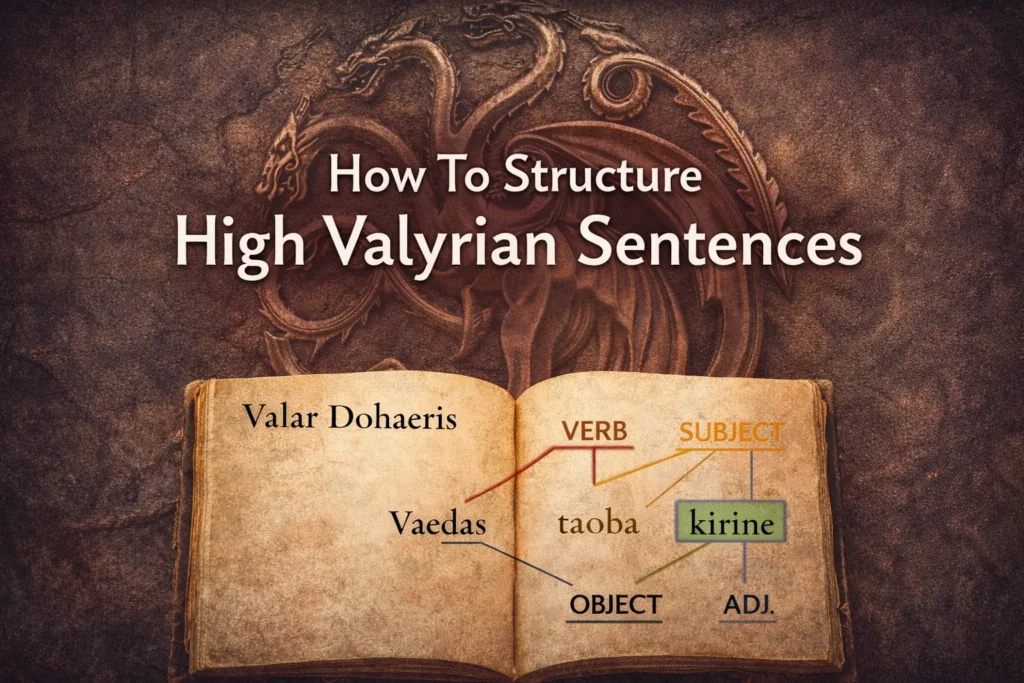
High Valyrian is a complete constructed language, not a handful of show phrases. It has subject-object-verb word order (so “I you love” instead of “I love you”), eight noun cases, four noun classes, and seven verb tenses. That sounds intimidating, but here’s the reassuring part: it’s regular. Peterson designed it systematically, which means the rules you learn in week one still apply in year one. There are far fewer nasty exceptions than in natural languages.
Step 3: Get yourself a dictionary
You need one reliable reference you can search quickly. A free 400-word High Valyrian dictionary with a searchable table and a downloadable PDF covers the core vocabulary you’ll meet in the shows and in beginner materials: https://highvalyriantranslators.com/high-valyrian-dictionary/
Bookmark it. You’ll open it daily — to check a word, to drill vocabulary, to settle arguments with friends about what a line really means.
Step 4: Shadow show dialogue for pronunciation
Pick a scene you love — the Astapor scene is perfect — and speak along with the actors in real time, matching their rhythm and stress. This technique is called shadowing, and it’s the fastest way to train your mouth on unfamiliar sounds. Start with one sentence (“Zaldrizes buzdari iksos daor”), repeat it twenty times, then add another. Ten minutes a day of this will transform your accent within weeks.
Step 5: Learn twenty words a week with spaced review
Don’t cram. Take twenty words from the dictionary each week, and review them on a schedule: the next day, three days later, a week later. Fifteen minutes of daily review beats two hours on Sunday. Within two months you’ll recognize most of the High Valyrian spoken on screen — which is a genuinely thrilling moment.
Step 6: Learn one grammar rule at a time, inside real sentences
Resist the urge to memorize case tables. Instead, take a sentence you know and change one thing: make “Valar morghulis” into a question, negate “Dracarys”, or swap the subject of a sentence you like. Each change teaches you one rule in context. Grammar learned inside sentences you care about is grammar you’ll actually remember.
Step 7: Use it somewhere real
When learning high valyrian, join a community — a forum, a subreddit like r/learnvalyrian, a Discord server — and start using the language with other learners. Write a greeting. Translate a short quote. Ask a question in High Valyrian, however clumsily. Languages are for communication, and even a constructed one comes alive the moment you use it with another person.
Your first-week plan
If you want it concrete, here’s week one: Day 1–2, master the five phrases above out loud. Day 3–4, bookmark the dictionary and learn your first twenty words. Day 5, shadow one scene for ten minutes. Day 6, take one sentence and change its tense. Day 7, introduce yourself in High Valyrian somewhere other learners hang out. That’s it — one week, and you’re genuinely underway.
The journey from “valar morghulis” to real sentences is shorter than you think. Every fluent speaker started learning high valyrian exactly where you are now: with five phrases, a dictionary, and curiosity.
Learning high valyrian: what comes after week one
Once the basics feel comfortable, the natural next layer is simple grammar: how to make a sentence negative, how to ask a question, how to talk about the past. High Valyrian’s regularity is your friend here — each new rule unlocks dozens of sentences, because the patterns repeat everywhere. Many learners find that working through one small grammar topic per week, always inside real sentences rather than abstract tables, keeps progress steady without burnout. And don’t worry about the descendant dialects like Astapori Valyrian yet — that’s advanced material for when the classical form feels like home.
Welcome aboard — or as we’d say, kirimvose for joining us.
Amir Hussain is the founder of High Valyrian Translators, where he maintains free High Valyrian learning tools, a 400-word dictionary, and beginner grammar guides.