
High Valyrian Numbers Chart (1–100)
... content here ...
... content here ...
... more content ...
... more content ...
... content here ...
... more content ...
Are you trying to learn how to count in the language of the dragonlords? No matter if you’re a fantasy writer, a roleplayer, or a die-hard House of the Dragon fan, learning High Valyrian numbers is an essential step in your language journey.
... content here ...
... content here ...
... content here ...
... more content ...
... content here ...
... more content ...
... more content ...
... content here ...
... more content ...
... content here ...
... content here ...
... more content ...
... more content ...
... content here ...
... more content ...
... more content ...
... content here ...
... more content ...
... content here ...
... content here ...
... more content ...
... more content ...
... content here ...
... content here ...
... more content ...
... more content ...
Created by linguist David J. Peterson for the Game of Thrones universe, the High Valyrian number system is a logical, base-10 system. Use our interactive translator below to convert any number up to 9,999, or scroll down to learn the grammatical rules behind Valyrian counting!
... content here ...
... more content ...
... content here ...
... content here ...
... more content ...
... more content ...
... content here ...
... more content ...
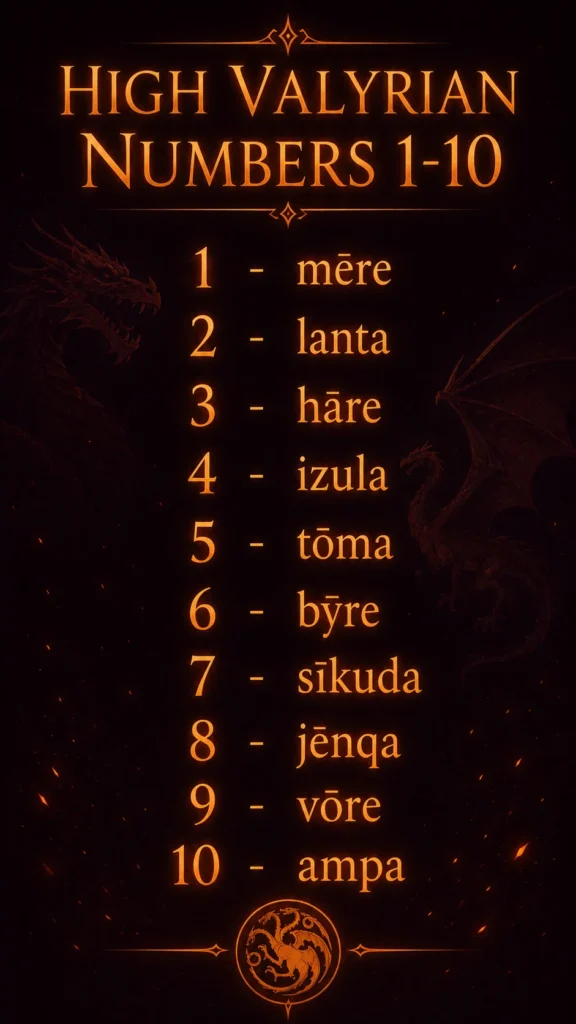
High Valyrian Numbers Chart (1–100)
| Number | High Valyrian | Number | High Valyrian |
|---|---|---|---|
| 1 | mēre | 51 | mēre izulēpsā |
| 2 | lanta | 52 | lanta izulēpsā |
| 3 | hāre | 53 | hāre izulēpsā |
| 4 | izula | 54 | izula izulēpsā |
| 5 | tōma | 55 | tōma izulēpsā |
| 6 | bȳre | 56 | bȳre izulēpsā |
| 7 | sīkuda | 57 | sīkuda izulēpsā |
| 8 | jēnqa | 58 | jēnqa izulēpsā |
| 9 | vōre | 59 | vōre izulēpsā |
| 10 | ampa | 60 | tōmēpsa |
| 11 | mēre ampā | 61 | mēre tōmēpsā |
| 12 | lanta ampā | 62 | lanta tōmēpsā |
| 13 | hāre ampā | 63 | hāre tōmēpsā |
| 14 | izula ampā | 64 | izula tōmēpsā |
| 15 | tōma ampā | 65 | tōma tōmēpsā |
| 16 | bȳre ampā | 66 | bȳre tōmēpsā |
| 17 | sīkuda ampā | 67 | sīkuda tōmēpsā |
| 18 | jēnqa ampā | 68 | jēnqa tōmēpsā |
| 19 | vōre ampā | 69 | vōre tōmēpsā |
| 20 | lantēpsa | 70 | bȳrēpsa |
| 21 | mēre lantēpsā | 71 | mēre bȳrēpsā |
| 22 | lanta lantēpsā | 72 | lanta bȳrēpsā |
| 23 | hāre lantēpsā | 73 | hāre bȳrēpsā |
| 24 | izula lantēpsā | 74 | izula bȳrēpsā |
| 25 | tōma lantēpsā | 75 | tōma bȳrēpsā |
| 26 | bȳre lantēpsā | 76 | bȳre bȳrēpsā |
| 27 | sīkuda lantēpsā | 77 | sīkuda bȳrēpsā |
| 28 | jēnqa lantēpsā | 78 | jēnqa bȳrēpsā |
| 29 | vōre lantēpsā | 79 | vōre bȳrēpsā |
| 30 | hārēpsa | 80 | sīkudēpsa |
| 31 | mēre hārēpsā | 81 | mēre sīkudēpsā |
| 32 | lanta hārēpsā | 82 | lanta sīkudēpsā |
| 33 | hāre hārēpsā | 83 | hāre sīkudēpsā |
| 34 | izula hārēpsā | 84 | izula sīkudēpsā |
| 35 | tōma hārēpsā | 85 | tōma sīkudēpsā |
| 36 | bȳre hārēpsā | 86 | bȳre sīkudēpsā |
| 37 | sīkuda hārēpsā | 87 | sīkuda sīkudēpsā |
| 38 | jēnqa hārēpsā | 88 | jēnqa sīkudēpsā |
| 39 | vōre hārēpsā | 89 | vōre sīkudēpsā |
| 40 | izulēpsa | 90 | jēnqēpsa |
| 41 | mēre izulēpsā | 91 | mēre jēnqēpsā |
| 42 | lanta izulēpsā | 92 | lanta jēnqēpsā |
| 43 | hāre izulēpsā | 93 | hāre jēnqēpsā |
| 44 | izula izulēpsā | 94 | izula jēnqēpsā |
| 45 | tōma izulēpsā | 95 | tōma jēnqēpsā |
| 46 | bȳre izulēpsā | 96 | bȳre jēnqēpsā |
| 47 | sīkuda izulēpsā | 97 | sīkuda jēnqēpsā |
| 48 | jēnqa izulēpsā | 98 | jēnqa jēnqēpsā |
| 49 | vōre izulēpsā | 99 | vōre jēnqēpsā |
| 50 | tōmēpsa | 100 | gār |
How the High Valyrian Number System Works
High Valyrian uses a standard base-10 system, making it relatively easy for English speakers to learn. However, because numbers in High Valyrian function as adjectives, they carry unique grammatical rules.
1. Numbers Must Agree with Nouns
In High Valyrian, there are four grammatical genders: Lunar, Solar, Terrestrial, and Aquatic. When you use a number to describe a noun (e.g., “two dragons”), the number must change its ending (decline) to match the gender and case of the noun.
- Terrestrial: lanta (two)
- Solar: lantyz (two)
- Lunar: lanti (two)
- Aquatic: lantra (two)
2. Forming Numbers 11 to 19
To count from 11 to 19, you simply take the single-digit number and add ampā (which is the coordinative form of “ampa”, meaning 10).
- 11 = mēre ampā
- 12 = lanta ampā
- 15 = tōma ampā
3. Counting by Tens (20, 30, 40…)
To form multiples of ten, take the base number, drop the final vowel, and add the suffix -ēpsa.
- 20 = lantēpsa
- 30 = hārēpsa
- 50 = tōmēpsa
Note: The number 10 (ampa) and all multiples of 10 ending in -ēpsa are invariant, meaning they do not change form to match noun genders.
High Valyrian Ordinal Numbers
If you want to say “first,” “second,” or “third” (instead of one, two, three), you must use ordinal numbers. Like standard numbers, these are adjectives and must agree with the noun they modify.
- 1st: ēlie
- 2nd: tȳne
- 3rd: saelie
- 4th: izulīe
- 5th: tōmīe
- 6th: byrīe
FAQs
Related Resources
... content here ...
... more content ...
... content here ...
... more content ...