
High Valyrian Adjectives: Best Guide to 4 Degrees
Table of Contents
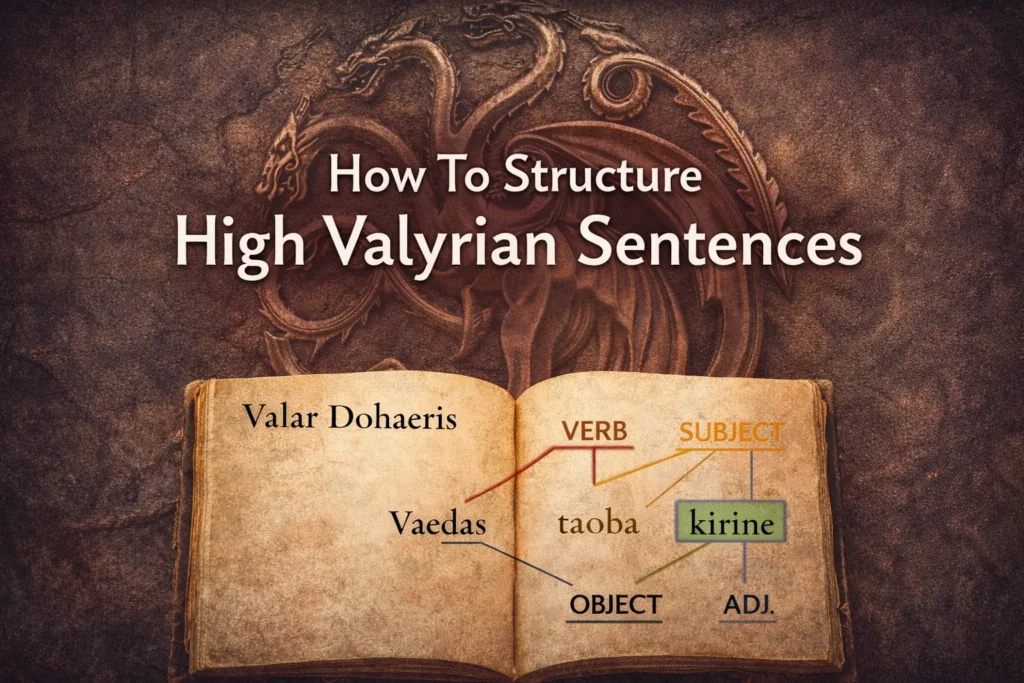
High Valyrian adjectives never sit still. Where English “good” looks the same in “good man,” “good woman,” and “good dragons,” the Valyrian equivalent reshapes itself for every noun it touches — changing its ending to match the noun’s class, number, and case. This agreement system is the heart of the language’s grammar, and once you understand its logic, the shifting forms start to feel systematic rather than random — that is the promise of mastering High Valyrian adjectives.
Quick Answer
High Valyrian adjectives agree with the nouns they modify in noun class (lunar, solar, terrestrial, aquatic), number, and case — for example, “good” is sȳz in the nominative singular but sȳri in the nominative plural. Adjectives usually come before the noun, have four degrees of comparison (positive, comparative, superlative, equative), and use the instrumental case to express “than.” That agreement is what makes High Valyrian adjectives both challenging and logical.
What Adjective Agreement Actually Means
Agreement means High Valyrian adjectives copy three features from their noun. First, the noun’s class: lunar, solar, terrestrial, or aquatic — the four genders that organize the entire nominal system. Second, the noun’s number: singular or plural (paucal nouns take plural agreement, collective nouns take singular agreement — adjectives have no special paucal or collective forms of their own). Third, the noun’s case: all eight of them, from nominative to vocative.
A concrete pair shows it in miniature. The adjective “good” is sȳz in the nominative singular and sȳri in the nominative plural — both forms documented in the Duolingo course materials. “Beautiful” is gevie in the nominative singular and gevī in the nominative plural. “Happy” is kirine (singular) and kirini (plural). The meaning never changes; only the ending moves to match the noun. For the full picture of the case system these endings track, see our High Valyrian grammar rules overview.
The Three Adjective Declension Classes
High Valyrian adjectives decline according to one of three declension classes, conventionally labeled I, II, and III. The class is a property of the adjective itself — listed in the High Valyrian dictionary — and it determines which set of endings the adjective takes as it agrees with its noun.
- Class I — e.g. vēzenka (a class I adjective). Comparatives and equatives also belong to class I.
- Class II — e.g. sȳz “good” (a class II adjective); superlatives are class II as well.
- Class III — e.g. gevie “beautiful,” olvie “much, many,” sylvie “wise.”
You do not need to memorize full paradigms on day one. What matters is the habit: whenever you write an adjective, ask what class, case, and number its noun has, then pick the matching form. A solar-class example from the course materials shows how much can change: “large/big” is rōvys (nominative singular), rōvi (accusative singular), rōvyz (nominative plural), and rōvī (accusative plural). Four forms, one meaning, all driven by agreement.
Position: Before the Noun, Usually
High Valyrian adjectives most commonly precede the noun they modify, and in that position they take what the grammar calls the prepositive form — shorter endings, with more cases merged together. They may also follow the noun, taking the postpositive form, which has more elaborate endings and fewer mergers.
The choice is not random. A postposed adjective gives the phrase a more “official” or formal feel, and it can add emphasis. Possessive adjectives in particular very often follow the noun — a pattern covered in our High Valyrian pronouns guide — so seeing the adjective after the noun is completely normal, not a mistake. Determiners and demonstratives are the exception: they almost always precede.
Four Degrees of Comparison
High Valyrian adjectives have four degrees of comparison: positive, comparative, superlative, and equative. The positive is the plain dictionary form (“good”). The other three are built with suffixes:
| Degree | Meaning | Suffix | Adjective class | Attested example |
|---|---|---|---|---|
| Positive | X (“good”) | — | varies | sȳz “good” |
| Comparative | more X (“bigger”) | -kta (or similar) | Class I | rovyktys “bigger” |
| Superlative | most X (“biggest”) | -je | Class II | formed with a -je suffix |
| Equative | as X (“as tall”) | -pa | Class I | bōsāpa “as tall” |
The comparative is documented in a famous attested sentence: Davido zaldrīzes aōhos zaldrīzose rovyktys issa — “David’s dragon is bigger than your dragon.” Two things are worth noticing. First, “bigger” is rovyktys, a class I adjective built on the stem of “big” with the comparative suffix. Second, “than your dragon” is not a separate word at all — the compared noun takes the instrumental case (aōhos zaldrīzose, “by means of your dragon”). There is no Valyrian word for “than”; the case ending does the job.
The equative — “as X as Y” — works the same way. The attested proverb Sȳndroso lykāpa, myrdomy aderpa, iēdrosa gīdāpa (“Quiet as a shadow, swift as a deer, calm as still water”) builds each “as X” on an -pa adjective with the compared noun in the instrumental. And the classic question Hae skorot vala bōsāpa issa? (“How tall is the man?”) shows the equative bōsāpa (“as tall”) doing the work English gives to “how … -“.
From Adjectives to Adverbs
Adverbs are formed regularly from High Valyrian adjectives with dedicated suffixes — the Valyrian equivalent of English “-ly.” Class I adjectives (including comparatives, superlatives, and equatives) take -irī or -rī; class II and class III adjectives take -ī. So sȳrī means “well,” built straight from sȳz “good.” Dative, locative, instrumental, and comitative noun forms are also commonly pressed into service as adverbs, which is one more reason the case system repays study.
Agreement in Practice
Putting it together with High Valyrian adjectives, translating “the good dragon” requires three decisions: the noun zaldrīzes is solar, the phrase is nominative singular, and the adjective “good” is class II — so the form must be the class II, solar, nominative, singular form of “good.” Make the dragons plural and the adjective shifts to its plural form; make the dragon the object of the sentence and both noun and adjective move to the accusative together. They always move as a pair. That is the whole secret: never decline the noun without declining its adjective to match. You can cross-reference these forms on the public High Valyrian wiki.
The most frequent agreement errors — leaving the adjective in its dictionary form while the noun changes case, or matching number but forgetting class — are covered in our roundup of common High Valyrian mistakes. If you want to sanity-check a phrase you have built, run it through the Valyrian to English translator and see whether each word is parsed with the case and class you intended, or draft from English with the English to Valyrian translator and compare the adjective endings it produces.
Related Valyrian Tools
- Valyrian to English translator — verify High Valyrian adjectives in phrases you write.
- English to Valyrian translator — draft English descriptions and study the Valyrian forms.
- High Valyrian dictionary — check each adjective’s declension class.
- High Valyrian phrases — see adjectives agreeing in real phrases.
Frequently Asked Questions
Do High Valyrian adjectives change for gender?
Yes — High Valyrian adjectives agree with their noun’s class (lunar, solar, terrestrial, aquatic), which is High Valyrian’s version of grammatical gender. They also agree in number and case, so a single adjective can have many forms.
Where does the adjective go — before or after the noun?
Usually before the noun, in the shorter prepositive form. After the noun is also grammatical and sounds more formal or emphatic; possessive adjectives very often follow the noun.
How do you say “bigger” and “biggest” in High Valyrian?
The comparative (“bigger”) is rovyktys, built with the -kta comparative suffix as a class I adjective. The superlative (“biggest”) is formed with a -je suffix as a class II adjective. To say “bigger than X,” put X in the instrumental case — there is no separate word for “than.”
How do you say “as tall as” in High Valyrian?
Use the equative degree: the -pa suffix on a class I adjective, with the compared noun in the instrumental. The attested example is Hae skorot vala bōsāpa issa? — “How tall is the man?” (literally, “The man is as tall as what?”).
Do High Valyrian adjectives have paucal and collective forms?
No. Adjectives only distinguish singular and plural: paucal nouns take plural adjective agreement and collective nouns take singular agreement. So “a few good men” and “good men” use the same adjective form.
How are adverbs formed from High Valyrian adjectives?
With suffixes: -irī/-rī for class I adjectives (and for comparatives, superlatives, and equatives), -ī for class II and III adjectives. For example, sȳz “good” gives sȳrī “well.”
Adjective agreement looks like a mountain of endings until you see the pattern: class, number, case — three questions, one matching form. Answer those three questions for the noun, pick the adjective’s class from the dictionary, and the ending chooses itself. Drill it with a handful of nouns from the High Valyrian dictionary, and High Valyrian adjectives will become the most automatic part of your Valyrian.