High Valyrian vs English: Key Differences Explained
High Valyrian and English could hardly be more different in how they build sentences — yet both are tools for saying the same kinds of things. Comparing High Valyrian vs English side by side is one of the fastest ways to grasp what makes High Valyrian tick: where English uses word order and helper words, High Valyrian uses word endings; where English has no grammatical gender, High Valyrian has four noun classes; and where English spells sounds plainly, High Valyrian marks vowel length with macrons.
This High Valyrian vs English guide walks through the major differences (and the few real similarities) so you know exactly what you’re getting into when you translate between the two languages.
Quick Answer
The biggest High Valyrian vs English differences are structural: High Valyrian uses subject-object-verb word order (English uses subject-verb-object), marks grammatical roles with eight noun cases instead of relying on word order and prepositions, sorts nouns into four classes (lunar, solar, terrestrial, aquatic) rather than having no gender, and distinguishes long vowels written with macrons. English has a vastly larger vocabulary, while High Valyrian’s documented lexicon numbers in the thousands.
Word Order in High Valyrian vs English: SOV vs. SVO
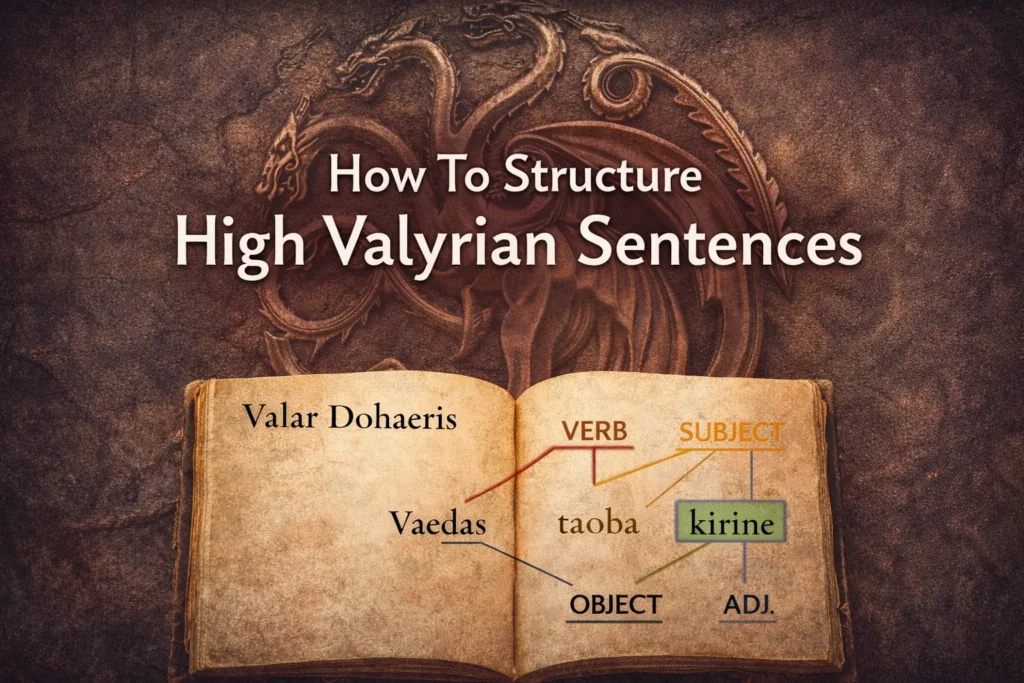
The most immediate difference is where the verb goes. English is subject-verb-object: “The knight sees the dragon.” High Valyrian’s default order is subject-object-verb, which rearranges the same idea to something like “The knight the dragon sees.” Because noun cases mark who is doing what to whom, the order can shift for emphasis without changing the meaning — a flexibility English mostly lacks.
For an English speaker, the High Valyrian vs English word-order switch takes deliberate practice. When drafting a High Valyrian sentence, it helps to first rearrange your English into SOV order, then translate each piece — the same strategy experienced conlang translators recommend.
Noun Cases vs. Prepositions and Word Order
English marks a noun’s role mainly through position and little helper words: “to the dragon,” “with the dragon,” “of the dragon.” High Valyrian instead changes the noun’s ending across eight cases. This is the single biggest conceptual leap for English speakers, and it is also what makes the language feel ancient — Latin and Ancient Greek worked the same way.
| Case | High Valyrian strategy | English strategy |
|---|---|---|
| Nominative (subject) | Noun takes the nominative ending | Word order: “the dragon flies” |
| Accusative (object) | Noun takes the accusative ending | Word order: “I see the dragon” |
| Genitive (possession) | Noun takes the genitive ending | “of” or ‘s: “the dragon’s fire” |
| Dative (indirect object) | Noun takes the dative ending | “to / for”: “give it to the dragon” |
| Locative (place) | Noun takes the locative ending | “in / at”: “in the city” |
| Instrumental (means) | Noun takes the instrumental ending | “with / by”: “with a sword” |
| Comitative (company) | Noun takes the comitative ending | “together with”: “with her sister” |
| Vocative (address) | Noun takes the vocative ending | “O dragon!” |
Notice how in the High Valyrian vs English comparison, English needs a different preposition for almost every row, while High Valyrian needs only the right ending. Once the case system clicks, High Valyrian sentences often feel more compact than their English equivalents.
Noun Classes vs. No Grammatical Gender
English has no grammatical gender for nouns — a table is just “it.” High Valyrian assigns every noun to one of four classes: lunar, solar, terrestrial, or aquatic. These are not masculine/feminine distinctions; they are categories of word shape that control declension and adjective agreement. Lunar nouns like vala (“man”) typically end in a vowel, while solar nouns like azantys (“knight”) typically end in -s.
The practical consequence for High Valyrian vs English learners: in English you memorize a word’s meaning, but in High Valyrian you must also memorize its class, because adjectives and case endings depend on it. Dictionaries built for learners, including our High Valyrian dictionary, list this information alongside each entry.
Sound and Spelling
English spelling is famously irregular; High Valyrian spelling is phonetic but adds one feature English lacks: vowel length. Long vowels are written with macrons — ā ē ī ō ū ȳ — and length can distinguish words, so a and ā are as different as two separate letters. English speakers must learn to hear and write the distinction — a classic High Valyrian vs English stumbling block — since English treats vowel length as a side effect of stress rather than a meaningful contrast.
High Valyrian also contains sounds English doesn’t have, such as the rounded vowel y (like German ü). Pronunciation guides on the phrases page can help you hear how the language is meant to sound.
Verbs and Sentence Building
In any High Valyrian vs English comparison, English verbs are relatively simple: a handful of forms (“speak,” “speaks,” “spoke,” “spoken,” “speaking”) plus helper verbs. High Valyrian verbs conjugate richly for tense, aspect, mood, voice, and person, packing into a single word what English spreads across several. This makes High Valyrian verbs harder to learn but more expressive per word — one inflected form can carry the meaning of an entire English verb phrase.
Vocabulary Size
Here, in the High Valyrian vs English vocabulary stakes, English wins by orders of magnitude. English has hundreds of thousands of words; High Valyrian’s documented vocabulary numbers in the thousands — large for a television language, but finite and shaped by what the shows needed. Everyday modern concepts often have no documented Valyrian word, which is why translation sometimes requires reconstruction, as explained in our guide to how High Valyrian translation works. If you want to see the documented stock for yourself, browse the High Valyrian dictionary.
What the Two Languages Share
For all their differences, the High Valyrian vs English comparison isn’t entirely one-sided. Both languages build new words from roots and affixes, both have idioms and ritual formulas (think “break a leg” next to valar morghulis), and both are shaped by the cultures that use them — High Valyrian’s formal, inflected character mirrors the hierarchical world of the dragonlords, just as English’s sprawling vocabulary mirrors its history of borrowing. Learning High Valyrian ultimately teaches you as much about English as about Valyrian: you notice your own language’s habits only when another language breaks them.
Related Valyrian Tools
- Valyrian to English translator — decode High Valyrian text into English
- English to Valyrian translator — render English phrases in High Valyrian
- High Valyrian dictionary — look up documented words and meanings
- High Valyrian phrases — common phrases with English translations
Frequently Asked Questions
Is High Valyrian harder than English?
For an English speaker, yes at first: eight cases, four noun classes, SOV order, and vowel length are all unfamiliar machinery. But the grammar is fully regular and documented, with none of English’s chaotic spelling — many learners find it gets easier once the case system clicks.
Why does High Valyrian put the verb last?
Subject-object-verb is simply the language’s default order, chosen by its creator to feel ancient and distinct from English. Because cases mark each noun’s role, the verb can sit at the end without ambiguity.
Do I need to learn the noun classes to translate?
Yes — a noun’s class (lunar, solar, terrestrial, or aquatic) determines its endings and how adjectives agree with it. Any English to Valyrian translation that ignores class will look wrong to anyone who knows the grammar.
Which language has more words?
English, by far. High Valyrian’s documented vocabulary is in the thousands — impressive for a constructed language, but a fraction of English’s hundreds of thousands of words. Gaps in the lexicon are the main reason translations sometimes need reconstruction.
Can English idioms be translated into High Valyrian?
Not word for word. Idioms must be rephrased into their underlying meaning first, then rendered with documented Valyrian words. A literal translation of an English idiom will usually produce nonsense.
Does learning High Valyrian help with other languages?
It can. The case system resembles Latin, Ancient Greek, Russian, and Finnish; the noun classes echo grammatical gender in French or German. Wrestling with these concepts in a small, regular language makes them easier to meet again in a big natural one.
High Valyrian vs English: the two languages take opposite routes to the same destination — English leans on order and helper words, High Valyrian on endings and inflection. Neither approach is better — but seeing both side by side reveals the hidden machinery inside every sentence you speak.