
Learn High Valyrian: Best Beginner Roadmap in 7 Steps
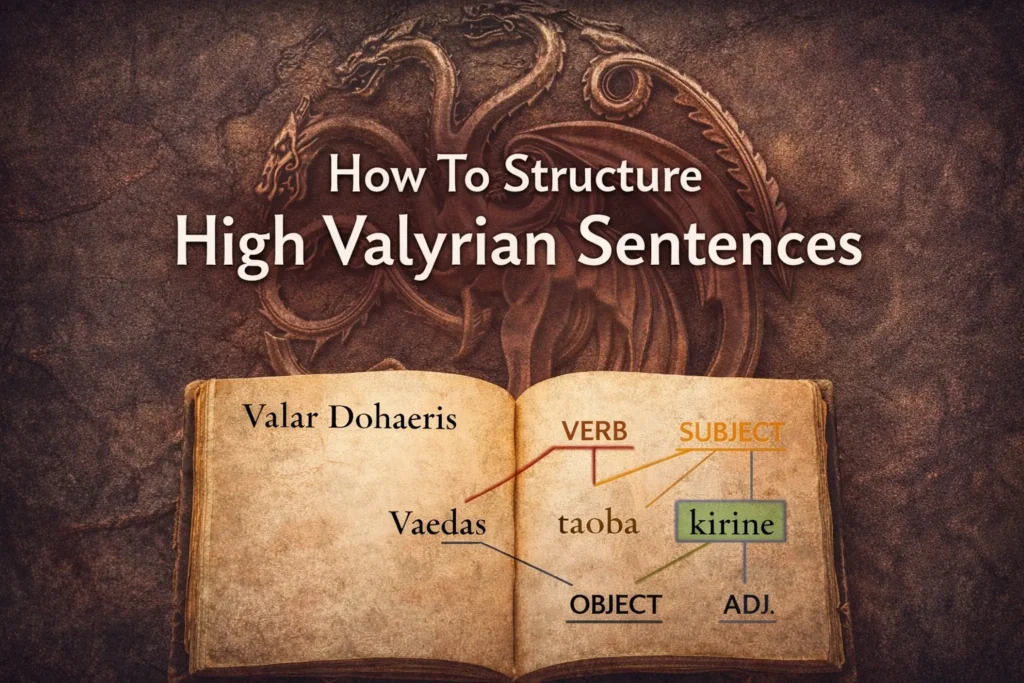
To learn High Valyrian as a beginner, start with the sound system: High Valyrian is the constructed language created by linguist David J. Peterson for HBO’s Game of Thrones and House of the Dragon. In George R. R. Martin’s novels it appears only as a handful of scattered words, but Peterson expanded it into a complete language with documented grammar and a growing vocabulary. To learn High Valyrian, beginners need a roadmap: this Learn High Valyrian Beginners Roadmap breaks the journey into four clear phases, from your first sounds to your first real conversations.
Quick Answer
To learn High Valyrian as a beginner, start with pronunciation and the sound system, then learn the core grammar — SOV word order, the four noun classes, and basic verb patterns — before building vocabulary in themed sets of 10–20 words. With 20–30 minutes of daily study, most learners can hold simple conversations within three to six months.
Set Honest Expectations First
Before diving in, it helps to know exactly what you are signing up for. High Valyrian is a real, learnable language: its grammar is fully documented on the public High Valyrian wiki at wiki.dothraki.org, the lexicon holds several thousand documented words and keeps growing, and the grammar is systematic — eight noun cases, four noun classes, and a default subject–object–verb word order. People genuinely read, write, and converse in it.
At the same time, it is not like learning Spanish or French. There are no native speakers, media input is limited to the shows’ dialogue, and the once-popular Duolingo High Valyrian course existed for several years before being discontinued, so there is currently no single guided course to carry you from zero to fluent. You will be building your own path from reference materials, which is entirely doable — it just means your study plan matters more. If you are still on the fence, read our honest breakdown of whether you can actually learn High Valyrian before committing.
Phase 1 — Pronunciation First (Days 1–14)
Start with the sound system, not the dictionary. High Valyrian spelling is mostly phonetic, which is good news, but it has a few features English speakers must learn deliberately: long vowels marked with macrons (ā ē ī ō ū ȳ), a consistently trilled r, and a rounded y pronounced like the German ü. Getting these right early prevents bad habits that are painful to unlearn later, and it makes every word you memorize afterwards sound correct from the start.
Spend ten minutes a day reading short phrases aloud — valar morghulis (“all men must die”), kessa (“yes”), daor (“no/not”) — and comparing your speech to dialogue clips from the shows. Our full High Valyrian pronunciation guide walks through every vowel and consonant with English approximations, and it is the single best companion for these first two weeks.
Phase 2 — Learn the Grammar Skeleton (Weeks 3–8)
Vocabulary without grammar is just a word list. High Valyrian’s grammar is logical but unfamiliar, so this Learn High Valyrian Beginners Roadmap gives grammar a dedicated phase before you chase word counts.
Word order is SOV
English puts the verb in the middle (“I see the dragon”); High Valyrian puts it at the end (subject–object–verb). Train yourself to think in this order from day one, because translating English sentences word-for-word is the most common beginner mistake. The language is also pro-drop, meaning subject pronouns like nyke (“I/me”) are usually omitted unless you want emphasis.
The four noun classes
Instead of masculine and feminine, High Valyrian nouns belong to one of four classes — lunar, solar, terrestrial, and aquatic — which determine how words decline. Learn to identify a noun’s class the moment you learn the word itself; flashcards that omit the class will cost you later.
Cases and no articles
There are eight noun cases, and there is no word for “a” or “the” — context does that work. Do not try to master all eight cases at once. Learn the nominative and accusative thoroughly first, add the rest gradually, and look up forms in a High Valyrian dictionary as you read real sentences.
Phase 3 — Build Core Vocabulary (Weeks 9–12 and Beyond)
With pronunciation and basic grammar in place, this Learn High Valyrian Beginners Roadmap shifts vocabulary to the main engine of progress. Aim for 200–300 well-chosen words first: pronouns, the most common verbs, greetings, and everyday nouns. That range covers the bulk of ordinary conversation, and everything after it is specialization.
Learn words in themed sets of 10–20 (family, food, travel, dragons) rather than random lists, always with the noun class and an example sentence attached. Spaced-repetition flashcards are the most efficient tool here — fifteen new cards a day is sustainable for most people. For the full method, see our guide on how to memorize High Valyrian vocabulary, which covers twelve techniques from memory palaces to interlinear reading.
Phase 4 — Start Producing Language (Months 3–6)
Understanding is only half the skill. From month three onward, this Learn High Valyrian Beginners Roadmap moves you from studying to producing: write a three-sentence diary entry, describe your day, or translate short English sentences into Valyrian and then check your work. A practical workflow is to draft a sentence yourself, run it through an English to Valyrian translator to compare, and study the differences — the comparison teaches more than either step alone.
Memorize whole phrases, not just words, from our collection of High Valyrian phrases; prefabricated chunks like kirimvose (“thank you”) give you fluent-sounding speech while your grammar catches up. If you can find a study partner or an online conlang community, even a weekly fifteen-minute exchange will accelerate you enormously, because real conversation forces retrieval under pressure.
Learn High Valyrian Beginners Roadmap: A 12-Week Study Plan
Here is a realistic plan assuming 20–30 minutes of study per day. Adjust the pace to your life, but protect the daily habit — consistency beats intensity.
| Weeks | Focus | Daily task | Milestone |
|---|---|---|---|
| 1–2 | Pronunciation | Read phrases aloud 10 minutes; drill long vs. short vowels | You can read any phrase aloud confidently |
| 3–4 | Core grammar: SOV order, pronouns | Build 5 simple subject–object–verb sentences | You think in SOV without translating word-for-word |
| 5–6 | Noun classes and core cases | Decline 5 new nouns daily; always note the class | You recognize lunar, solar, terrestrial, aquatic nouns |
| 7–8 | Verb basics | Conjugate 3 common verbs; write short paragraphs | You can describe simple actions in the present |
| 9–10 | Core vocabulary (150 words) | 15 new flashcards a day with example sentences | 150-word active vocabulary |
| 11–12 | Conversation practice | Translate and write daily; memorize 20 phrases | You can hold a simple 2-minute exchange |
Five Mistakes Beginners Should Avoid
- Skipping pronunciation. Long vowels marked with macrons change words; learn them before they fossilize wrong.
- Memorizing words without grammar. A noun without its class and a verb without its pattern is half a word.
- Ignoring the noun classes. Lunar, solar, terrestrial, and aquatic drive declension — learn the class with every noun.
- Translating English word-for-word. SOV order and pro-drop mean literal translation produces broken Valyrian.
- Studying in bursts. Twenty minutes daily beats a five-hour weekend cram for long-term retention.
Wondering how the timeline above compares for different study schedules? If you follow this Learn High Valyrian Beginners Roadmap consistently, the estimates in our guide on how long it takes to learn High Valyrian will apply directly to you.
Related Valyrian Tools
- Valyrian to English translator — decode Valyrian sentences you read or hear.
- English to Valyrian translator — check your own Valyrian sentences as you practice.
- High Valyrian dictionary — look up words, meanings, and noun classes.
- High Valyrian phrases — memorize ready-made phrases for conversation.
Frequently Asked Questions
Is High Valyrian hard to learn for beginners?
It is moderately challenging — roughly comparable to learning Latin or German grammar. The eight noun cases and four noun classes are unfamiliar to English speakers, but the system is regular and well documented, so steady study pays off predictably. Pronunciation is easier than the grammar because spelling is largely phonetic.
Do I need to watch Game of Thrones or House of the Dragon first?
No, but it helps. The shows give you an ear for how the language sounds and motivation to keep going. All the grammar and vocabulary you need are documented on the public wiki regardless.
How many words do I need to know?
Around 200–300 well-chosen words handle everyday conversation, which is why this Learn High Valyrian Beginners Roadmap targets 200–300 words in the first twelve weeks. The documented lexicon holds several thousand words, so there is plenty of room to grow into specialized topics like dragons, warfare, or courtly speech afterward.
Can I become fluent in High Valyrian?
You can reach genuine conversational ability — reading, writing, and speaking about everyday topics. “Native-like fluency” is not really attainable for any constructed language with no native speakers, but functional fluency absolutely is.
Is there an official course for learning High Valyrian?
Not currently. Duolingo offered a High Valyrian course for several years before it was discontinued, so today’s learners build their own path from the wiki, dictionaries, phrase collections, and translator tools like the ones on this site.
Learning High Valyrian rewards the same thing every language rewards: a small daily habit, protected for months. Follow this Learn High Valyrian Beginners Roadmap — sounds, grammar skeleton, core vocabulary, then real production — and you will move from sounding out dracarys to holding your own in simple conversation faster than you expect. Valar dohaeris: all learners must serve the daily streak.